
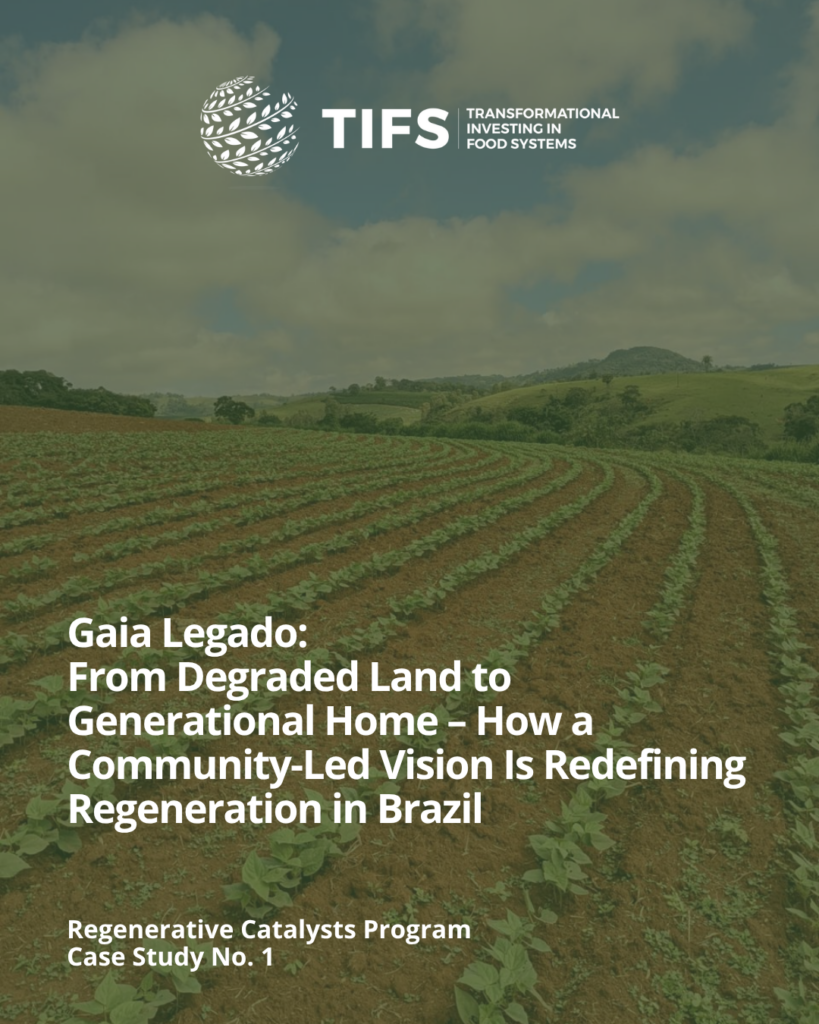
Context: A Country, A Movement, A Donated Farm
Brazil ranks among the most unequal countries in the world in terms of land distribution. More than 145,000 families are landless nationwide, yet vast stretches of the country’s agricultural landscape are given over to monocultures of soy and cattle, concentrated in the hands of a relatively small number of large landowners. In the transition of the Cerrado and Mata Atlântica, a globally significant biome covering much of central and southeastern Brazil, decades of intensive farming have degraded soils, depleted water systems, and erased biodiversity.
Gaia Legado is a Brazilian initiative dedicated to driving impact across both investment and grantmaking portfolios. While enabling individuals and institutions to convert their giving into a lasting legacy. In 2024, João Pacifico, founder of Grupo Gaia, a São Paulo-based impact organization created in 2009 and working at the intersection of finance and social and environmental change, received what he initially thought was spam: a landowner wanted to donate their farm. The property is a 1,500-hectare conventional farm in Campo Belo municipality, Minas Gerais. It had been used for cattle and soy production, with a small amount of coffee and significant chemical inputs. The owner, aware of Grupo Gaia’s activism and social media presence, wanted to see it transformed.
What followed was, in João’s words, “a wonderful journey.”
The Initiative: Regenerating Land, Community, and Livelihoods
Gaia Legado, an Endowment Fund Management Organization, is the vehicle through which Grupo Gaia channels this transformation. It ensures that the land can never be sold or converted to private profit, remaining permanently dedicated to its ecological and social mission. Gaia Legado develops the initiative in partnership with the MST (Movimento dos Trabalhadores Rurais Sem Terra), Brazil’s Landless Workers Movement, and one of the largest social movements in the world.
The Joaquim Rosa Cambraia (JRC) Project, named in honor of the landowner’s father, is one of Gaia Legado’s first initiatives. The goal is to house 100 landless families on the farm in sustainably built homes, transition 1,500 hectares from degraded monoculture to agroecological systems including a coffee agroforestry, and supply regeneratively grown food to 1,000 schoolchildren through Brazil’s National School Feeding Program (PNAE), which mandates that 45% of public school food be sourced from family farming.
Two governance structures underpin the model: a cooperative through which residents organize the production and generate income, and a community association that organizes social life. The MST, with its deep experience in land reform and agroecological training, leads technical implementation and local coordination, while Grupo Gaia provides financial coordination, strategic direction, and external partnerships. Critically, the land will never be sold; it belongs to the entity in perpetuity, with both chemicals and land speculation explicitly prohibited under the model’s founding rules. For João, this is the point: regeneration here is not only ecological. It encompasses people, food systems, landscape, and the creation of lasting meaning for families who will call this place home for generations.
The partnership between the MST and Gaia in the JRC project has strengthened collective construction within the territory by articulating technical knowledge and popular wisdom. This is reflected in the advancement of agroecology, the organization of families, cooperation, and the strengthening of productive and environmental initiatives funded by the endowment fund.
For the MST, the partnership must continue to deepen its roots in the territory — expanding the leadership of families and their learning processes, always guided by the broader strategy of Popular Agrarian Reform.
The initiative is structured in a way that can be replicated. Grupo Gaia sees an opportunity for a growing pipeline of land donations across Brazil, a country with vast areas of degraded agricultural land and an urgent need for alternative models. The JRC Project serves as a proof of concept for a scalable template that combines endowment governance, MST partnership, agroecological transition, and public procurement as a market anchor.
Progress to Date
Despite being at an early stage of implementation, Gaia Legado has made significant foundational progress:
- The land donation of more than 1,500 hectares has been legally formalized through an endowment structure, locking land use to ecological and social purposes in perpetuity.
- A governance architecture is in place, including the cooperative and community association structures developed by the MST.
- Six houses have been built and 12 families (30 adults and 14 children) are already settled on the land.
- 1,200 hectares of pasture, 32 hectares of agroforestry, 23 hectares of grain crops and 12 hectares of coffee are currently in active regenerative transition, with social technologies including bioinputs, nurseries, and shared machinery drawn from MST infrastructure in the region.
- $2 million USD has been raised, funding the foundational phase of development.
- A partnership with Ecosia supports tree planting at scale, and documentary production is underway through Nós Filmes to tell the story of the transformation.
The overall financing needed for the next phase, covering housing for 50 families, transitioning 1,200 hectares, and launching the school meal supply program, is approximately $10 million USD to be raised through a combination of grants and concessional debt over the coming years.
With Brazil’s benchmark interest rate currently at 14.50%, domestic borrowing is prohibitively expensive, making international philanthropic and catalytic capital especially critical at this stage.
The TIFS Partnership: Connecting Local Impact to Global Capital
When Grupo Gaia first engaged with TIFS through the Regenerative Catalysts Program, they brought deep expertise in impact investing and financial innovation within Brazil, but almost no experience with international fundraising or the language and structures of global philanthropy.
“We had almost never spoken to people abroad or in other cultures,” João reflected. ” We had raised money through impact investing. We had no expertise in raising donations from other institutions.”
TIFS occupies a distinctive position in the food systems finance landscape: not as a capital provider, but as a force that shapes the conditions under which capital, policy, markets, and community innovation can converge. For initiatives like Gaia Legado, which are too complex for traditional investors and too capital-intensive to rely on philanthropy alone, this kind of strategic support is often the decisive difference.
In practice, TIFS’ support has spanned several interconnected areas. On communications and narrative, TIFS has helped the Gaia Legado team translate their deeply local, highly innovative model into language and frameworks that resonate with international audiences. This has included supporting the creation of investment documents, videos, and outreach materials that represent the initiative authentically to global audiences. TIFS has also connected Gaia Legado with aligned donors and foundations and has hosted convenings that introduced the initiative to wider networks in the global regenerative finance community.
Looking further ahead, Grupo Gaia envisions a financing pathway that evolves from the current grant-dependent stage toward CRA instruments (Certificado de Recebíveis do Agronegócio), a Brazilian debt financial tool that converts future agricultural revenues into investable securities, enabling commercial and concessional capital to flow into the cooperative and the land transition without relying on continued philanthropy.
TIFS also conducted a structured assessment of Gaia Legado across its core analytical frameworks — covering regenerative pathway, maturity, scale, organizing structure, partnership models, and multi-capital returns — available in full here.
The Funding Gap: Why the Right Capital Matters
Gaia Legado illustrates with unusual clarity the structural challenge that the Regenerative Catalysts Program is designed to address. The initiative has all the ingredients of a transformative model: robust legal structures, a credible land base, one of the world’s most experienced social movements as a partner, and a replication roadmap. What constrains its pace is capital.
“The land cannot do anything without money,” João said plainly. “The pace of the project depends on money.”
For those seeking a project rooted in deep, transformative, and long-term regeneration, this model offers a unique opportunity. The initiative occupies a singular space that challenges conventional philanthropic frameworks. While it does not focus on short-term scale, it is built for permanence, prioritizing profound local impact over rapid expansion. Consequently, Gaia Legado focuses on partnerships with foundations that share its vision, maintaining an unyielding commitment to its core principles and the project’s integrity.
This insistence on integrity is, in itself, a proof point for the Regenerative Catalysts model: demonstrating that deep regeneration is possible without compromising on governance, ecology, or community sovereignty.
Vision: Planting Seeds for a Generation
Within three to four years, Gaia Legado aims to achieve financial self-sufficiency through the cooperative’s market revenues and its evolving financing structures, including CRA instruments adapted for family farming and agroforestry. The goal is a model in which the community generates its own income, the endowment protects the land in perpetuity, and the JRC Project becomes a living demonstration of what is possible.
João’s vision extends far beyond the first farm. “Brazil is a big country with many devastated areas,” he said. “I would love to see many projects like this one. No one being landless. This could be replicated, with Grupo Gaia or without us.”
Tuíra Tule, National Coordinator of the MST, hopes the project “continues to serve as an instrument to articulate and strengthen the territory and cooperation, generating income, autonomy, the production of healthy food, and the stewardship of nature’s resources.”
The immediate priorities for 2026 and 2027 reflect that ambition: housing the next wave of families, continuing and expanding the agroecological transition, training community members in regenerative practices, accessing the school meal program, and codifying the legal and governance frameworks so they can be open-sourced and made available to other actors in Brazil and beyond.
Lessons for the Field
Depth of impact is not always visible in numbers alone
The initiative aims to directly impact 500 people in its first phase, but the ripple effects are harder to quantify: ecological restoration across 1,500 hectares, the permanence of community land tenure, and the inspiration the project may provide for other land donation processes across Brazil and beyond. These are families who will live on this land permanently, building livelihoods and communities across generations — a depth of impact that numbers alone struggle to capture.
Social and ecological transformation are inseparable
A recurring risk in regenerative agriculture is the prioritization of carbon outcomes or biodiversity metrics at the expense of the communities who live on and steward the land. Gaia Legado integrates both dimensions from its founding logic: the MST brings the people and the grassroots legitimacy, the agroecological model restores the ecology, and the governance structure binds them together in perpetuity. Treating environmental and social goals as separate objectives misses the point of what makes this model work.
Catalytic capital at the early stage is irreplaceable
Without grant funding to build foundational infrastructure, including houses, agroecological training, and the initial land transition, none of the subsequent financing layers, such as the cooperative’s revenues, CRA instruments, and concessional debt, can materialize. Catalytic capital does not simply fund activities; it makes the model investable and opens the door to a much larger pool of capital over time. For entrepreneurs and organizations designing similar models, this sequencing is not incidental — it is structural.
Governance innovation is the core differentiator
What makes the JRC Project genuinely replicable is not a particular crop system or technology but a set of legal and governance innovations: the endowment structure that locks land use in perpetuity, the cooperative and association framework that distributes economic rights to community members, and the partnership with MST that provides organizing capacity at scale. These frameworks are being designed from the outset to be open-sourced and transferable. In a country that faces a massive, decade-long intergenerational transfer of wealth, these frameworks offer a blueprint for other actors across Brazil and beyond who are working to align land, community, and capital toward regenerative ends.
About the Regenerative Catalysts Program
TIFS’ Regenerative Catalysts Program partners with leading place-based regenerative initiatives to strengthen their financial frameworks, investment readiness, and market connections. The program is designed to help promising initiatives bridge the Missing Middle, moving from proof of concept toward durable, system-level change.
To learn more or explore collaboration, contact Rex Raimond at rraimond@tifsinitiative.org.