
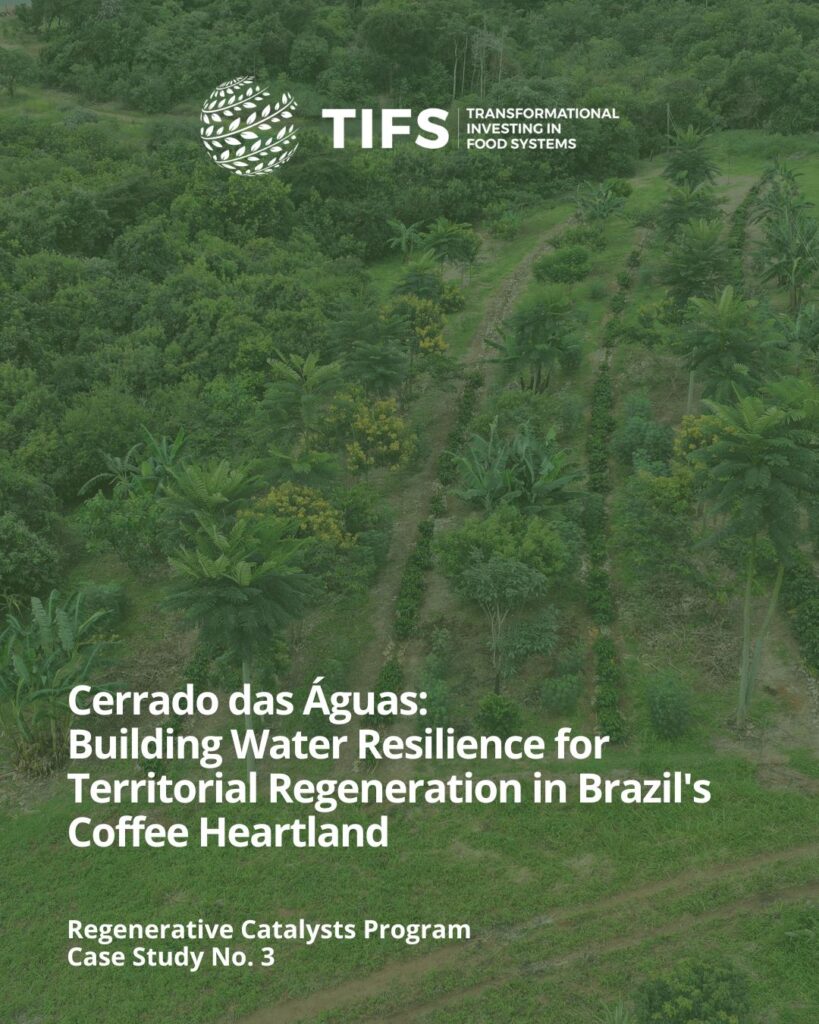
Context: A Biome Under Pressure
The Cerrado — Brazil’s vast tropical savanna and one of the world’s most biodiverse biomes — is also the country’s agricultural engine. It is the source of eight of Brazil’s twelve major river basins and provides water to hundreds of millions of people. It is also where some of Brazil’s most important coffee-growing regions are located, and where decades of intensive agriculture have exacted a steep ecological toll: degraded soils, diminished water infiltration, and stressed watersheds that once sustained both communities and crops.
In this landscape, water is not merely an environmental concern: it is an existential one for coffee producers, agribusiness companies, and the communities whose livelihoods depend on the land. Yet until recently, the response to mounting water stress was fragmented: companies and producers each confronted the challenge alone, rarely seeing their fates as intertwined.
Cerrado das Águas emerged from the recognition that fragmentation within the sector was itself part of the problem. A platform for territorial regeneration uniting competing companies, farmers, research institutions, and public agencies around a common mission — to orchestrate systemic change and tackle climate challenges in an integrated manner — Cerrado das Águas represents a fundamental shift in how the coffee sector approaches its relationship with the landscape that sustains it.
The Initiative: Pre-Competitive Collaboration for Territory Resilience
The Cerrado das Águas defining insight is deceptively simple: the health of any individual farm depends on the health of the entire watershed. A producer who manages soil and vegetation well cannot insulate themselves from the consequences of poor land management upstream or downstream. Shared ecological fates require shared governance and shared investment.
At the heart of the Cerrado das Águas model is the concept of pre-competitive collaboration: bringing together companies that compete in the marketplace to cooperate on the foundational conditions their businesses require. In the Cerrado, that foundation is water. By reframing water security as a shared responsibility rather than an individual cost, Cerrado das Águas has united large corporations (direct competitors outside Cerrado das Águas) around a common agenda.
Cerrado das Águas defines regenerative agriculture broadly: any practice that revitalizes the soil and improves water infiltration. This includes restoring permanent conservation areas and Legal Reserves, reconnecting forest fragments essential to local flora and fauna, and investing in soil biology and agroecological systems that reduce dependence on chemical inputs. Cerrado das Águas supports producers in making this transition through technical assistance, shared knowledge, and access to the networks and resources that smallholder farmers rarely reach on their own.
Two governance challenges sit at the center of this work. The first is institutional: persuading competing companies to lower their competitive guards and collaborate on pre-competitive infrastructure. The second is cultural and territorial in nature: moving beyond the view of water as an isolated resource to understand it as the ultimate reflection of the health of a fully regenerated landscape, which encompasses soil, biodiversity and community. This shift in mindset requires producers to see themselves as key players in the rehabilitation and resilience of the entire region. Orchestrating this cultural and governance transformation requires a strategic, patient, and sustained commitment over time.
“Our greatest asset lies in our ability to act as catalysts for transformation, bringing together different sectors and global competitors around a systemic purpose and a long-term local impact.”
— Fabiane Sebaio, Executive Director, Cerrado das Águas
Progress to Date
Cerrado das Águas is not simply implementing projects within an existing system. It is actively building the ecosystem required for landscape-scale change in a region where such coordination did not previously exist. Operating in a biome where water systems, agricultural productivity, and ecological integrity are deeply interdependent, Cerrado das Águas has emerged as a connective platform that aligns actors who historically operated in isolation.
Today, its network bridges global industry and local producers, linking multinational coffee buyers with smallholder farmers while extending outward to key enabling institutions. Partnerships with organizations such as SEBRAE and leading academic centers, including the Federal University of Uberlândia, the Federal University of Itajubá, and the Federal University of Viçosa, have helped embed technical rigor and regional credibility into the model. At the same time, early investment from funders such as the Critical Ecosystem Partnership Fund, Funbio, the Cargill Foundation, and the Rabobank Foundation has served as a powerful validation signal, reshaping how both public and private actors perceive Cerrado das Águas and accelerating broader participation.
What is emerging is not a collection of discrete interventions but a reinforcing system of change already producing measurable ripple effects across the landscape.
In ecological terms, the restoration of Permanent Preservation Areas and Legal Reserves is beginning to reconnect fragmented habitats and reestablish ecological corridors in a region where biodiversity loss has long been treated as an externality. Just as significantly, this work is catalyzing a restoration economy, reviving native seed networks, nurseries, and technical services that were largely absent from the Cerrado’s agricultural value chains.
Economically, the transition to regenerative practices is generating new forms of local value creation. Supply chains for organic inputs, soil health services, and environmental restoration are taking root, diversifying income streams and embedding resilience into the regional economy rather than extracting from it.
Socially, Cerrado das Águas is contributing to a subtle but critical shift in the future of rural life. By linking climate resilience, innovation, and viable livelihoods, it is reshaping perceptions of farming, particularly among younger generations. What was once seen as a declining or precarious path is increasingly understood as a site of innovation and long-term opportunity, helping retain talent within farming communities.
At the systems level, improvements in soil health and watershed function are reinforcing both food and water security. More resilient soils retain moisture, reduce erosion, and stabilize yields, while restored vegetation supports more reliable hydrological cycles, benefiting not only coffee production but also subsistence agriculture and municipal water supplies downstream.
Perhaps most telling, however, is the shift in mindset taking hold among producers themselves. Regenerative practices were initially met with understandable caution, as they were perceived as risky departures from established methods. Yet as farmers begin to experience the cumulative benefits, greater soil stability, improved water availability, and reduced vulnerability to climate variability, adoption is no longer driven solely by external incentives. It becomes internally motivated and socially reinforced.
What once required persuasion is increasingly sustained by peer validation. Farmers who were early adopters are becoming advocates, translating lived experience into influence across their communities. In this way, Cerrado das Águas is not only changing practices on the ground; it is reshaping the underlying norms that determine how land is managed, turning what once seemed improbable into a durable, self-reinforcing transition.
The TIFS Partnership: Converting Potential into System Readiness
When Cerrado de Aguas engaged TIFS as part of the Regenerative Catalysts Program in August 2025, it faced a wider challenge: how to transform a sound model into a scalable, investable system. Envisioning the possibility of scaling up regenerative systems on smallholdings and promoting local trade in regenerative food, TIFS supported the development of the strategic vision and technical framework needed to make this possible. In the second half of 2025, weekly meetings were held with the TIFS team to jointly develop this expansion model, thereby avoiding the tipping point at which many initiatives stall. For Cerrado das Águas, this marked the moment when everything began to gather pace.
What TIFS brought was not an external strategy layered on top, but a disciplined methodology for unlocking what was already present. Grounded in the Cerrado das Águas stage of development, this approach helped transform existing strengths into something more durable: an organization ready to lead at scale. The partnership was defined by rigor and a shared commitment to building from local capability rather than overriding it.
That commitment showed up in practice. Through sustained, hands-on engagement from Rex Raimond and Murray Gray, strategy became an active process rather than a static plan. Weekly working sessions created a feedback loop where operational realities, financial constraints, and even vulnerabilities could be surfaced and worked through openly. What might otherwise have remained internal friction points became the foundation for a more resilient system.
“The support received in the second half of 2025 was a turning point: it provided strategic insights that allowed us to identify new opportunities for scaling up and to chart a clear roadmap of the actions needed to achieve our climate resilience goals.”
— Fabiane Sebaio, Executive Director, Cerrado das Águas
The result was a shift not only in capability but in positioning. TIFS supported Cerrado das Águas in strengthening its financial architecture and clarifying its role within a broader investment ecosystem.
Equally important, the combination of TIFS’ structured approach and validation from rigorous funders such as CEPF (Critical Ecosystem Partnership Fund) and Funbio functioned as a powerful market signal. The question surrounding Cerrado das Águas has fundamentally changed. The issue is no longer whether the model is viable; it is how quickly and effectively it can be scaled.
This is the distinct value of the TIFS partnership: not simply strengthening organizations, but converting proven models into vehicles that capital, partners, and systems can confidently move through.
The Missing Middle — Lived Experience
The Cerrado das Águas experience illuminates the structural gap that TIFS’ Regenerative Catalysts Program is designed to address. Cerrado das Águas possesses credible governance, deep local legitimacy, a proven technical approach, and a track record with major funders. What it has lacked — and what constrains its pace — is access to the right type of capital at the right stage.
The Cerrado das Águas current financial structure sustains operations and specific projects, but achieving its core mission (making the Cerrado region resilient to climate change) requires a different kind of capital. Corporate financing, which focuses on securing supply chains, is not the same as catalytic capital, which invests in securing the territory itself. The distinction is fundamental: one optimizes for individual company risk; the other invests in the ecological infrastructure on which all production ultimately depends.
“While corporate financing focuses on ‘securing the supply,’ catalytic capital invests in ‘securing the territory.’ It would give us the flexibility needed to implement systemic actions that benefit the watershed as a whole.”
— Fabiane Sebaio, Executive Director, Cerrado das Águas
Scaling the Cerrado das Águas model will require new financial mechanisms, including parametric insurance and other instruments capable of absorbing the transition risk that producers face in the early years of adopting regenerative practices. These mechanisms do not yet exist in adequate form for the region. Building them requires patient capital and the institutional credibility to convene the actors who can develop them.
The progress made by the Cerrado das Águas Consortium has reinforced the understanding that environmental conservation and productive efficiency in coffee farming are inseparable. However, to expand this successful model and achieve the necessary territorial scale in each river basin, we face a structural challenge that goes beyond traditional technical assistance: the financial transition risk that coffee farmers assume in the early years of adopting regenerative practices. It is in this context that the role of initiatives aimed at transforming food and finance systems and of a partnership with TIFS becomes essential. Scaling up will require the creation of innovative financial mechanisms, such as parametric insurance and other risk-mitigation instruments that do not yet exist in a form suitable for this region. Building these protection tools requires attracting patient capital and, fundamentally, the institutional credibility that Cerrado das Águas requires to convene and engage global and local actors capable of co-developing these solutions. Funding this work, therefore, means funding the strategic intelligence and cutting-edge financial instruments that will absorb producers’ risks, ensuring climate resilience and the long-term sustainability of the coffee supply for future generations.
What Funders Need to Understand About Risk
Cerrado das Águas’ leadership offers a candid challenge to prospective funders: the risks that matter most in the Cerrado are not fully captured by conventional metrics.
Ecosystem indicators such as the recovery of soil microbiota, the replenishment of aquifers, the restoration of forest connectivity operate on biological timescales that resist short-term measurement. The most consequential risks are not the ones that appear in quarterly dashboards; they are the slow-building threats that only become visible when they are irreversible.
There is also a relational dimension to risk that numbers cannot capture. The trust of a smallholder producer, built over years of consistent technical support and genuine partnership, is, in Cerrado das Águas’ words, “the scarcest and most valuable asset in the field.” The interruption of financing or the failure of a recommended practice can permanently close the door on a family’s willingness to engage with any future sustainability initiative. This kind of risk does not appear in a spreadsheet, but its consequences are real and lasting.
The Cerrado das Águas case for investment rests on a straightforward argument: the cost of mitigating the climate crisis now through investment in regenerative practices and watershed infrastructure is far lower than the cost of operating in a scenario of severe water scarcity in the future. Investing in Cerrado das Águas is not funding an isolated project; it is investing in the biological integrity and the trust relationships that make coffee, and the communities around it, viable for future generations.
Vision: A Replicable Model for Landscape Resilience
Cerrado das Águas’ ambitions extend well beyond the Cerrado. Cerrado das Águas is actively working to demonstrate that production and conservation are not competing objectives but interdependent ones, and that regenerative agriculture is not a philanthropic niche but the most sophisticated and economically rational response to the climate crisis available today.
This reframing carries broader significance. Across Brazil and beyond, smallholder farmers are too often cast as people who preserve land “out of obligation,” reluctant participants in environmental compliance frameworks. Cerrado das Águas is building evidence for a different identity: the “Producer of Climate Resilience,” who integrates science and nature to ensure food and water security for an entire territory. When producers understand that their farm’s resilience depends on the health of the whole watershed, they stop thinking inside the farm gate and begin acting as stewards of a shared landscape.
Cerrado das Águas’ immediate priorities include translating its frameworks into operational financing mechanisms, scaling its producer network, and formalizing governance structures that can be adapted and replicated across other Brazilian watersheds. Cerrado das Águas is in active dialogue with the National Coffee Council and the Ministry of the Environment, an indication of how far its influence has traveled from its origins as a regional initiative.
Lessons for the Field
Pre-competitive collaboration is possible — but it requires a trusted convener
Before Cerrado das Águas, companies in the coffee supply chain competed for water rather than cooperating to protect it. The Consortium has demonstrated that even direct competitors can be united around a shared ecological mission, but only when there is a credible, neutral convener capable of holding that space over time. Building this kind of trust is slow work; it cannot be accelerated by capital alone.
Cultural change is the hardest and most durable form of transformation
The shift from viewing water as an infinite, free resource to recognizing it as a productive input requiring active management is not a technical challenge; it is a cultural one. Cerrado das Águas has found that once producers internalize this shift, the behavioral change proves solid. But it requires continuous technical assistance, education, and the willingness to meet producers where they are, not where funders wish they were.
Catalytic capital unlocks a larger financing architecture
Cerrado das Águas’ experience confirms a structural truth about regenerative initiatives at this stage: grant and catalytic funding does not simply pay for activities; it makes the model legible and credible to a broader range of investors. Access to rigorous funders like CEPF and Funbio functioned as a quality signal that reduced perceived risk across the entire ecosystem. Without early, flexible capital to build this foundation, the subsequent financing layers cannot materialize.
Impact measurement must respect biological time
Short-term metrics cannot capture the depth of transformation underway in a regenerative landscape. Soil microbiota recovery, aquifer replenishment, and the reconnection of forest fragments operate on timescales that require patient, rigorous data collection. Funders who insist on linear, quarterly impact evidence will systematically undervalue and underfund the most important work.
About the Regenerative Catalysts Program
TIFS’ Regenerative Catalysts Program partners with leading place-based regenerative initiatives to strengthen their financial frameworks, investment readiness, and market connections. The program is designed to help promising initiatives bridge the Missing Middle, moving from proof of concept toward durable, system-level change. To learn more or explore collaboration, contact Rex Raimond at rraimond@tifsinitiative.org.